



Delta Chevrolet · Pittsburg, California
Chevy Equinox EV Range and Charging
Make electric driving fit your day. Explore home charging, charging times and NACS connections for the way you drive.
Start with your everyday drive
How Far Can an Equinox EV Go?
Both the 2026 and 2027 Equinox EV offer an EPA-estimated 319 miles with front-wheel drive or 307 miles with available all-wheel drive on a full charge.1 For your own week, start with the miles you drive and where the SUV will have time to charge.
Plan around the drive you actually make
An Antioch-to-Concord commute, errands around Pittsburg and a weekend drive toward the Sierra place different demands on the battery. Freeway speed, elevation, weather, cabin heating or cooling, load and battery condition affect energy use.
Use the vehicle's current range estimate and keep a reserve. On a longer trip, choose a compatible charging stop early enough that an occupied or unavailable station leaves you another workable option.
For equipment beyond charging, our 2026 Equinox EV trim guide explains the available choices.
Turn parking time into charging time
What Do You Need to Charge at Home?
A suitable 120-volt outlet can support Level 1 charging. A properly installed 240-volt Level 2 setup gives frequent drivers more ability to replace their daily energy while parked.
Level 1 · 120 volts
For smaller daily top-ups
Chevrolet's general guide lists up to 1.4 kW. This can suit modest energy needs and generous parking time, but check whether the energy recovered overnight covers your normal driving.
Use compatible charging equipment on a suitable circuit and follow the vehicle and charge-cord instructions.
Level 2 · 240 volts
For a regular home-charging routine
A qualified electrician can assess your electrical service, parking location and installation. Charging speed depends on installed power and the vehicle's AC charging limit.
The 7.7-kW and 11.5-kW examples below are planning scenarios. Higher charger output cannot override the vehicle's limit.
- Choose the parking space.Plan a cable route that reaches the charging port without crossing a walkway.
- Have the electrical service assessed.A qualified electrician evaluates the panel, circuit, installation method and permits.
- Match the equipment to the vehicle.Confirm the model year, connector, charger output and any required GM-approved adapter.
- Check your electricity plan.Use your actual rate and off-peak schedule when setting a charging routine.
Budget for the complete installation. Chevrolet offers access to installation services through Qmerit. Request a property-specific quote for equipment, labor, permits and any electrical upgrades. Renters and condominium owners should confirm property approval and parking access. Do not assume these costs are included with the vehicle.
Charging time, with the context that matters
How Long Does It Take to Charge?
Replacing the energy from one day's driving takes less time than charging an almost-empty battery. At home, compare the energy you need with the hours you will be parked.
120-volt example · 1.4 kW
15.9 hoursA small top-up needs time
Illustrative time to return 20 kWh to the battery at steady power and 90% efficiency.
240-volt example · 7.7 kW
2.9 hoursMore energy while parked
The same 20-kWh replenishment with the same assumed efficiency.
240-volt example · 11.5 kW
1.9 hoursOutput and vehicle limits matter
The same calculation, assuming the installation and vehicle support this power.
Calculated as 20 kWh ÷ (power × 0.90). These are illustrative replenishment times, not full-charge times, Chevrolet recharge ratings or guaranteed results. Temperature, equipment and vehicle limits affect actual sessions.2
2026 · Public DC fast charging
Approximately 42 minutes, 10% to 80%
Chevrolet lists up to 150-kW DC charging capability for the 2026 Equinox EV. Actual charging power changes during the session.2
2027 · Public DC fast charging
Up to 80 miles added in 10 minutes
This Chevrolet-published benchmark describes added range. It does not establish a 0–100% or 10–80% recharge time.2
Why does fast charging slow down?
Advertised peak power is not a constant rate from empty to full. Charging generally slows as the battery fills. Use the estimated completion time shown by the vehicle or station instead of multiplying a ten-minute range claim into a full-charge promise.
For a longer California drive, check compatible stations and a backup location, review your arrival charge and follow the vehicle's battery-preparation guidance. Allow time for waiting, connection and payment setup as well as the charging session.
The right connection for the right charger
Which Charging Connection Do You Need?
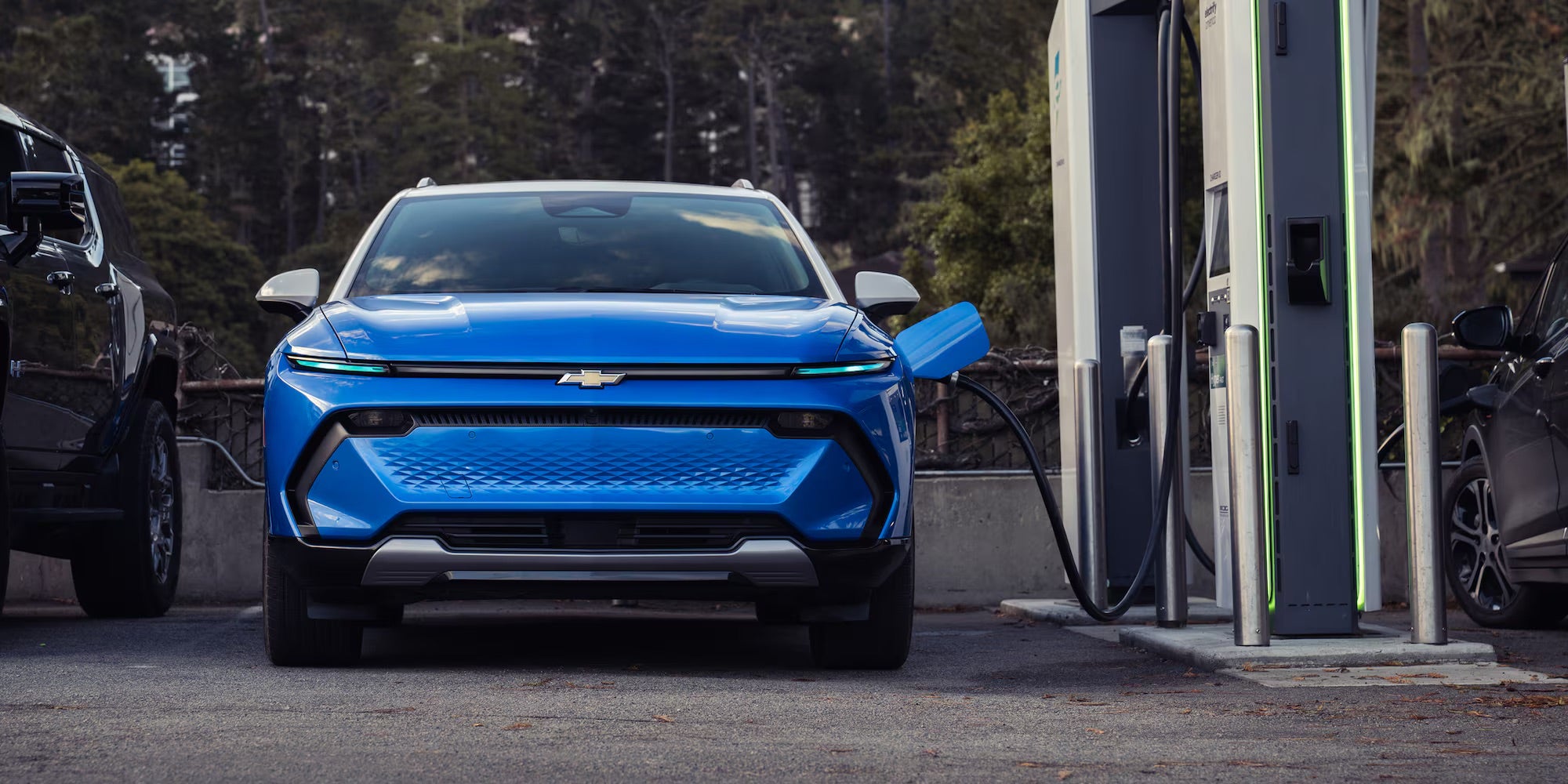
The 2027 Equinox EV has a standard NACS port. The 2026 uses CCS1/J1772. NACS means North American Charging Standard; AC home charging and DC fast charging still require the correct equipment for each job.
Your connection
Connect directly at compatible NACS fast chargers
The 2027 NACS inlet accepts a compatible NACS DC connector without an adapter. Check station eligibility in the myChevrolet app before your trip.
See every connector combination
2026 · CCS1/J1772 inlet
- NACS DC: GM NACS DC adapter.
- CCS1 DC: Direct connection at compatible stations.
- NACS Level 2: GM NACS Level 2 adapter.
- J1772 Level 2: Direct connection at compatible stations.
2027 · NACS inlet
- NACS DC: Direct connection at compatible stations.
- CCS1 DC: GM CCS1 DC adapter.
- NACS Level 2: Direct connection at compatible stations.
- J1772 Level 2: GM J1772 AC adapter.
A Supercharger adapter is not a home-charging adapter. For a 2026, the GM NACS DC adapter is for DC fast charging. A compatible NACS Level 2 charger requires the separate GM NACS Level 2 adapter. Use GM-approved equipment and confirm what comes with the specific vehicle.3
Check network access, app setup and specialized home systems
A matching plug does not make every site available to every vehicle. Check the myChevrolet app for compatible locations, access requirements, prices and current availability. Enroll in Energy Pass and set up payment for supported app features or Plug & Charge at participating stations. Features depend on the vehicle, account and network.
GM Energy PowerShift and vehicle-to-home systems have separate requirements. The standard GM J1772 AC adapter is not compatible with the PowerShift charger. Confirm the complete equipment combination before purchasing specialized home-energy hardware.
Make the numbers fit your routine
Estimate Your Charging Cost and Home Charging Time
Start with your daily or annual mileage. Adjust the electricity rates and charging mix to compare different routines. These are planning estimates using editable assumptions, not a quote or an EPA consumption rating.
Daily mileage is averaged across 365 days. Choose Year if you know your annual total.
Adjust rates, charging mix and energy use
Wall energy includes charging losses. Replace the example with your own data; do not add a second loss allowance. Select power supported by both the vehicle and installation.
Estimated electricity cost
- Annual electricity cost
- $1,314.00
- Per 100 miles
- $12.00
- Average home charging per day
- About 56 minutes
Example: 10,950 miles/year, 30 kWh/100 miles, 80% home charging, $0.35/kWh at home, $0.60/kWh in public and 7.7-kW home power.
Home time is the average daily share of energy charged at home divided by selected power. Actual sessions may be longer and less frequent. This does not estimate DC fast-charging time. Costs exclude equipment, installation, fixed utility charges and public session, idle, parking or membership fees.
For apartments, shared parking and busy weeks
No Home Charger? Test the Routine First.
Dependable workplace or public charging can make EV ownership practical. Before relying on it, visit your likely locations at the times you expect to charge.
- Check access hours, parking restrictions and how long you can stay.
- Compare the posted energy price and any additional fees.
- Allow for occupied chargers and keep an alternate location.
- Include errands and evening driving in your mileage estimate.
Your next step at Delta Chevrolet
Explore the SUV. Plan the Charging.
Visit us at 3750 Century Court in Pittsburg to compare available Equinox EV vehicles and discuss the charging equipment for the model year you choose. Our family's Bay Area automotive roots date to 1954, and our local team brings vehicle shopping, financing, trade planning, service and parts together.
Bring your daily mileage, parking situation and any charger details. Whether you are coming from Antioch, Concord, Oakley or Brentwood, those specifics help make the conversation useful for your household.
A few more charging questions
Equinox EV Range and Charging FAQs
What is the Chevy Equinox EV driving range?
For both 2026 and 2027, Chevrolet lists EPA-estimated full-charge range of 319 miles with FWD and 307 miles with available AWD. Your actual range depends on driving conditions, temperature, load and battery condition.
How long does it take to charge a Chevy Equinox EV?
There is no single time for every charger or battery level. Chevrolet lists about 42 minutes from 10% to 80% for 2026 DC fast charging and up to 80 miles added in 10 minutes for 2027. Home charging depends on installed power, vehicle limits and the energy you need to replace. Actual results vary.
Does the 2027 Equinox EV have a NACS port?
Yes. NACS is standard on the 2027 Equinox EV. The 2026 uses a CCS1/J1772 inlet and needs the appropriate GM-approved adapter to use compatible NACS equipment.
Can I use the same NACS adapter at a Supercharger and at home?
No. For a 2026 Equinox EV, the GM NACS DC adapter serves compatible DC fast chargers. A compatible Tesla Wall Connector or other NACS Level 2 charger requires the separate GM NACS Level 2 adapter. Always check vehicle and charger compatibility.
Should I charge my Equinox EV to 100% every day?
Chevrolet recommends an 80% target for regular Equinox EV charging. Follow the vehicle’s charging guidance when a longer trip calls for more energy, and use the current range estimate to plan your stops.
How much does it cost to charge an Equinox EV?
Multiply the electricity purchased in kWh by the applicable price per kWh. For example, 30 kWh at a hypothetical $0.35 per kWh costs $10.50 before any additional fees. Your usage, utility plan and public charging mix determine the actual cost.
Can I own an Equinox EV without a home charger?
Yes, if dependable workplace or public charging fits your mileage and schedule. Verify access hours, charging prices, parking rules and an alternative site before relying on that routine.
Does buying an Equinox EV include a home charging installation?
Do not assume installation is included. Charger equipment, installation, permits and electrical upgrades should be confirmed separately for your vehicle and property. Our Delta Chevrolet team can help identify vehicle and accessory requirements; a qualified installer evaluates the home electrical work.
Considering another electric model? Explore our Chevrolet electric vehicle selection.
Range and charging notes
1 EPA range figures apply to a full charge for the identified 2026 or 2027 drivetrain. Weather, terrain, battery age and condition, vehicle load and driving habits affect actual range.
2 Charging benchmarks are Chevrolet-published figures for the model year identified. Actual times vary with battery condition and temperature, charger output, vehicle settings and outside temperature. Consult the vehicle and charger manuals. The 2027 added-range claim does not establish its 10–80% recharge time. The 20-kWh home examples assume steady power and 90% wall-to-battery efficiency; calculator inputs instead use wall energy that already includes losses.
3 Use GM-approved adapters appropriate to the inlet and charging method. Network access, app features and equipment availability can change. Confirm compatibility before charging. Accessories and home installation are separate costs unless expressly included in your transaction.